
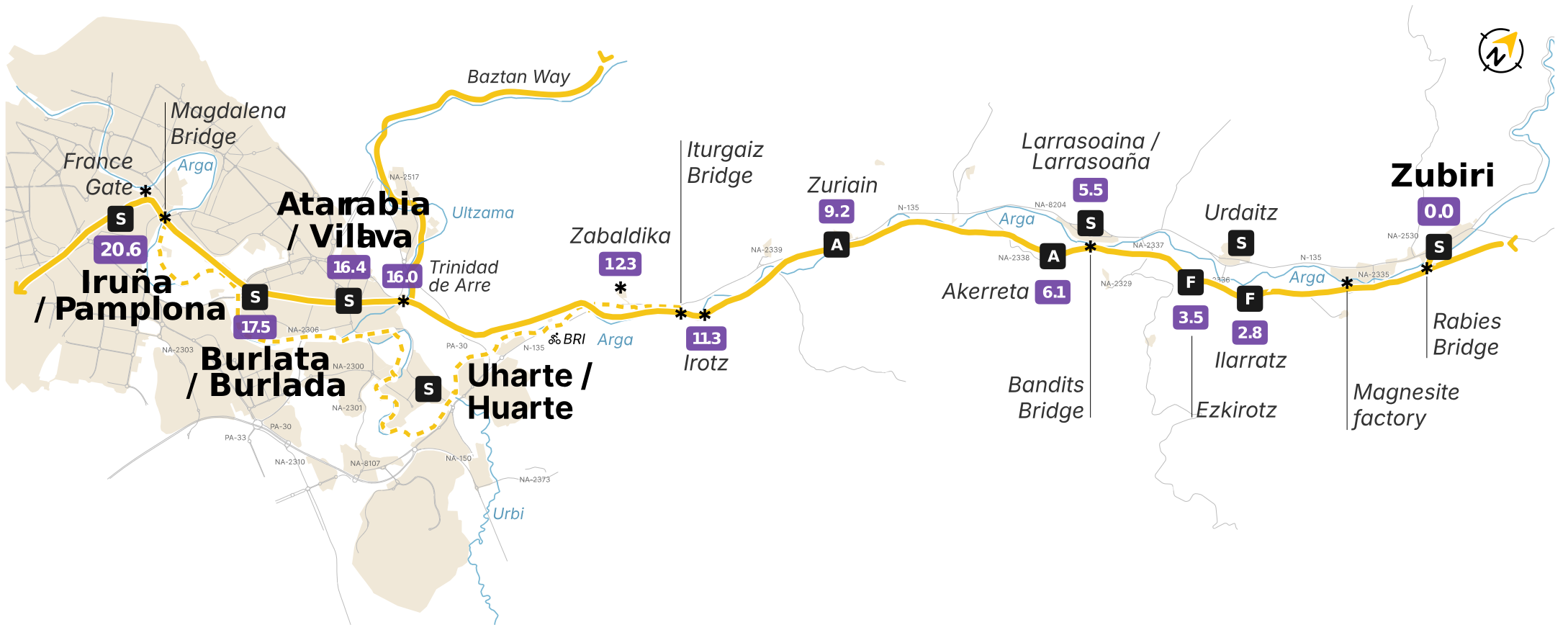
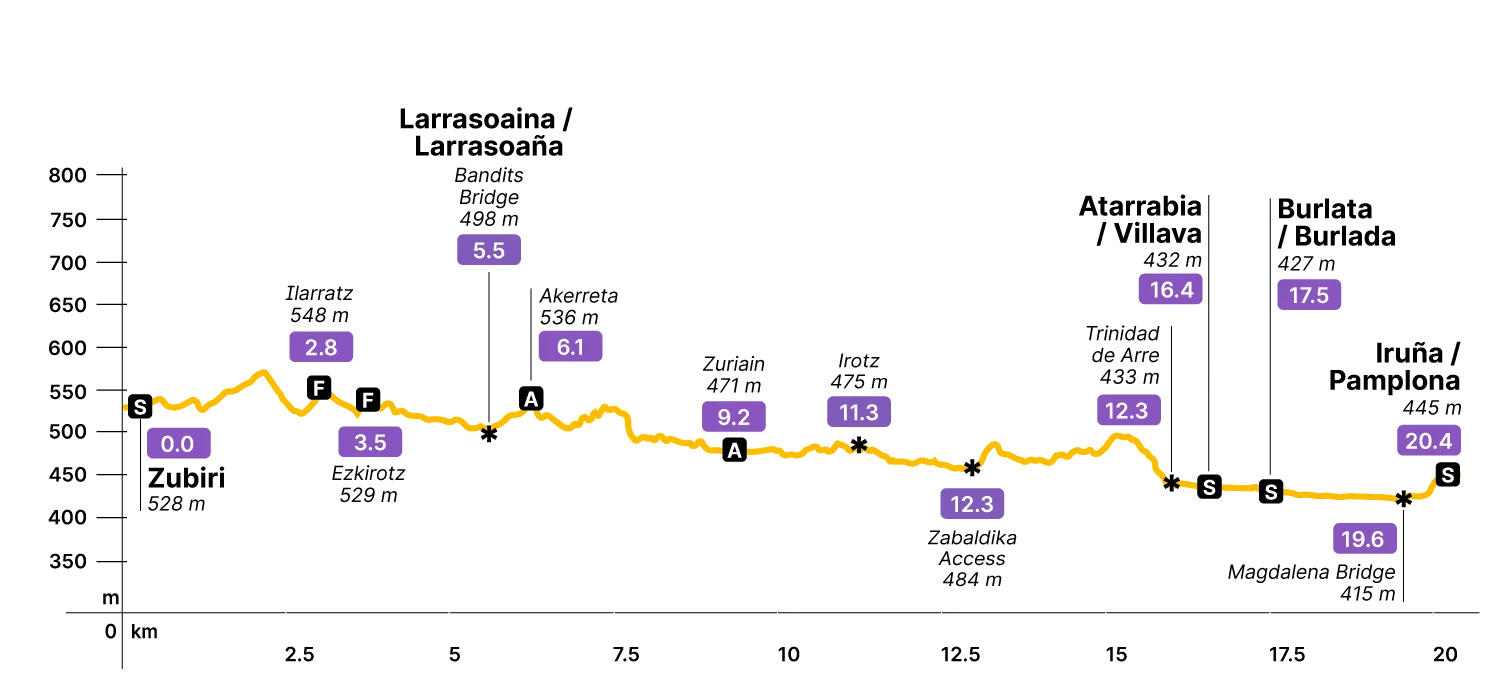
Stage Data 20.4 km · +476 m
In short
Most of this stage follows the banks of the Arga River through the Esteríbar valley — beautiful country that was, in the Middle Ages, a favorite haunt of bandits and robbers. It isn't anymore. Beech and pine forests give way to small medieval churches and 12th and 13th-century bridges over the Arga as you approach Pamplona.
Pamplona — Iruña or even Iruñea in Basque — is Navarre's capital, famous worldwide for the Sanfermines (running of the bulls) in July, but with a strong Jacobean identity of its own. Bear in mind that the last 4.5 km of the stage are fully urban: the towns of Atarrabia / Villava and Burlada / Burlata extend Pamplona's eastern edge with no gap. A stage to enjoy, with excellent Basque-Navarrese food.
Step by step
This is a stage with little elevation change, covered quickly. Some pilgrims use that as a reason to push on to Cizur Menor / Zizur Txikia, 5 km past Pamplona’s center. Most can’t resist stopping — and they’re right not to. Spend time in the old city, eat well, talk to people. You can always leave in the morning.
The stage begins at the Gothic bridge that connects Zubiri 0.0 with the Camino over the Arga — the river that will stay with you all the way to Pamplona. You’ll cross it several times, on bridges with names worth knowing. This first one is called the Bridge of the Rabies (puente de la rabia in Spanish, errabiaren zubia in Basque). Legend has it that local farmers would walk their cattle three times around its central pillar to cure them of rabies, drawing on the power of relics of Saint Quiteria buried beneath one of the abutments.
The first section doesn’t match the rest of the stage. Leaving Zubiri, you’ll skirt a large magnesite plant that has been processing metal for nearly 80 years. The factory itself is what it is. The real problem is the slag deposits that line the Camino, which the bodies responsible for protecting the route have done little to address.
The good news are that they’re soon behind you. From there, the path becomes pleasant and you approach two typical Basque-Navarrese hamlets: Ilarratz 2.8 and Ezkirotz 3.5, both with sources of drinking water. Between them, a short road leads to Urdaitz / Urdániz — just off the route, but with a good hostel if you need it. In the same stretch, look out for the remains of the hermitage of Saint Lucía, connected to the Benedictine Order.
Back to the Camino, you soon reach the next town with services: Larrasoaña / Larrasoaina 5.5 has a shop, restaurant, bars, and several accommodation options — a reasonable stop if Zubiri was full or if you want to break the stage here. The entrance to the village crosses the Arga again, this time over the Bandits’ Bridge — a name that points directly at what walking the Camino once involved. Bandits, robbers, disease, wild animals: for centuries these were ordinary hazards of the pilgrimage. The bridge is nowadays a good reminder that the walk you’re doing and the walk medieval pilgrims did share a route and very little else.
Larrasoaña / Larrasoaina appears in the Codex Calixtinus as a “village of Franks” as far back as 1174. The main street has good examples of Basque-Navarrese architecture, the oldest house dating to 1500. The church of Saint Nicholas of Bari retains original Gothic elements despite heavy 18th-century modifications.
Half a kilometer on, Aquerreta / Akerreta 6.1 offers one lodging and a curiosity: the church of the Transfiguration, which has been built into the surrounding houses in an unusual hybrid of temple and residence. The medieval tower, façade, and baptismal font survive. From here the Camino continues through forest with the Arga audible below.
The next point is Zuriain 9.2, which offers accommodation. The exit is uphill from the N-135 — you follow the road for 600 meters before a signposted left turn takes you back across the Arga toward Ilurdotz. Another 1.5 km brings you to Irotz 11.3, a good place to eat before the final stretch to Pamplona.
Just past Irotz, less than a kilometer along, you reach the Iturgaiz Bridge — originally Romanesque, substantially rebuilt in the 1940s, but still carrying the three-arch structure of a medieval crossing. More importantly, this is where you choose your route into Pamplona.
The right fork follows the historic Camino, passing heritage points — the church of Saint Stephen in Zabaldika, the hermitage at Trinidad de Arre — before a fully urban final stretch into the city. The left fork is the riverside variant, following the Arga toward Uharte / Huarte through parks and away from traffic. Both routes converge at the Magdalena Bridge, just before the old city. Both are well signed. Take your time.
Through the historic route
The right fork follows the historic Camino, passing heritage points before a fully urban final stretch into the city.
On foot, a short steep climb just past the bridge takes you up to Zabaldika 12.3 — a hamlet of around 30 people with a parish hostel and a Gothic-Romanesque church dedicated to Saint Stephen that is usually open. Inside: a Mannerist altarpiece, and in the tower, the oldest bell in Navarre, cast in 1377, which pilgrims can usually ring. The thing that stops most people, though, is the so-called Christ of the Post-its — a crucified figure surrounded by notes left by pilgrims over many years. Brief reflections, prayers, names of people back home. Worth a few minutes.
Cyclists should take the paved track into Zabaldika rather than the footpath climb.
From Zabaldika, the route passes through the old domain of Arleta — a few ruined houses — and the abandoned village of Burrin, then through a tunnel under the PA-30. A small hill follows. On the descent, you cross the Ultzama / Ulzama, a tributary of the Arga, and arrive at Trinidad de Arre 16.0. Here you may meet pilgrims arriving from a different direction — from the north. This is the Baztán Way, which joins the French Way at this point.
Arre mattered historically because it was the only natural passage between the hills of Ezkaba Txiki and Miravalles — the gap between the Esteríbar valley and the Pamplona basin. Its bridge over the Ultzama, the chapel, and the old tower formed a set that pilgrims from Roncesvalles and beyond the Pyrenees depended on. It still feels like a threshold.
From here, the towns come fast and close. Atarrabia / Villava 16.4 — over 10,000 inhabitants, all services — runs directly into Burlata / Burlada 17.5 with no visible boundary. Pay attention to the waymarks here; they compete with a lot of other signage. Before the end of Calle Mayor / Nagusia Kalea, turn onto Calle Larrainzar / Larrainzar Kalea toward the Magdalena road, which briefly escapes the urban fabric before delivering you to the Magdalena Bridge 19.9, where both routes into Pamplona converge.
Through the Arga riverbank
The left fork from Iturgaiz follows the Arga into Iruña / Pamplona — less traffic, almost no gradient, well-paved surfaces. The better option on a bike, and a genuinely pleasant walk.
Stay on the riverside road, passing under the PA-30 ring road, skirting Uharte / Huarte, then through a stretch of urban orchards that bypasses the industrial area of Areta. The route follows a long meander of the river, going around rather than through Burlata / Burlada. Both options meet at the Magdalena Bridge 19.9.
Entering Iruña / Pamplona
The Magdalena Bridge is where the two routes meet and where you cross the Arga for the last time on this stage. On the far side, a path climbs past the bastion of Our Lady of Guadalupe to the France Gate (Portal de Francia, Frantziako Atea), opened in 1553. Through it, you’re in the old city.
Carmen Street leads to the Navarrería junction: left for the cathedral, straight on for Mercaderes and then Estafeta — streets famous well beyond Pamplona as the course of the Sanfermines bull run.
The old city of Iruña / Pamplona 20.4 has everything: accommodation of every type, restaurants, bars, laundries, ATMs. Before you leave, try the pintxos (pintxoak) — ideally with a txakoli (young white wine) or a zurito (roughly a quarter pint of beer). This is one of the better urban stages on the French Way. Enjoy it.
Lodging data for this stage is being added. Check back soon.
Field notes on the churches, ruins, monasteries and small museums along this stage. In preparation.