
Sarria
Sarria is, without doubt, one of the defining stops on the French Way. Not the largest, not the most populated, not the one with the most historical weight — but in an rush era when many people walk the Camino with only a few free days to spare, it has become the most popular starting point on the route.
At 113.5 km (70.5 mi) from Santiago de Compostela, it sits just beyond the 100 km mark that qualifies pilgrims for a Compostela. With around 9,800 inhabitants, it has enough accommodation, services, and infrastructure to absorb the volume of people who arrive here every year — by bus from Santiago or Lugo ou by direct train from Madrid. How to get here is covered further down the page.
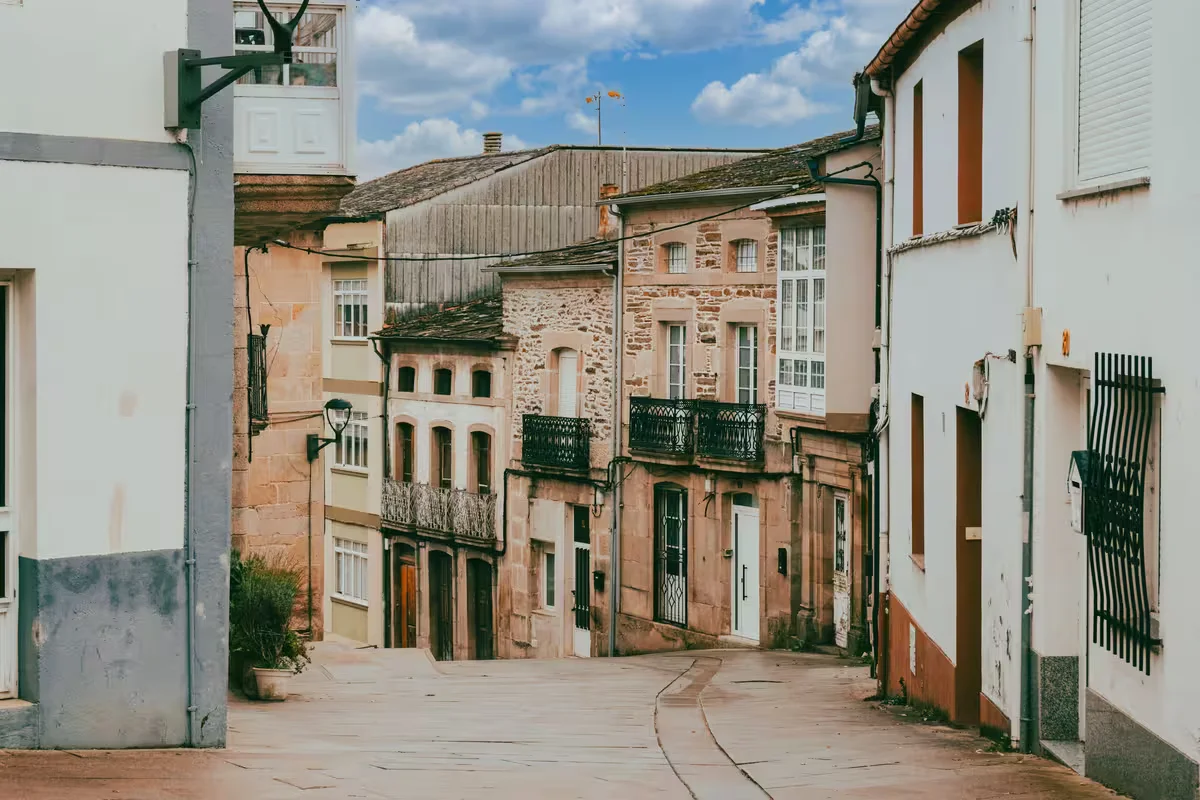
The nerve center for pilgrims is Rúa Maior, the main street that climbs from the lower town toward the site of a 12th-century fortress — of which only the Tower of Batallón survives.
Most pilgrim hostels, pensions, and services are here, along with the town’s main points of historical interest. The lower neighborhood, particularly along Peregrino and Liberdade streets where the Camino arrives from Triacastela or Samos, has good additional accommodation options.
A note: Calvo Sotelo street was officially renamed Liberdade in 2022, but older guides and websites still use the previous name.
What to visit in Sarria
Start at Rúa Maior. At the foot of the steps leading up to the street, a small fountain is almost always surrounded by pilgrims refilling bottles and canteens.
As you climb, the first lodgings appear and, just past them, the first church on the street — a good place to stamp your credential. This is the parish church of St. Mariña, built in 1885 in neo-Gothic style, as its bell tower makes immediately clear. Inside, the attention goes to three figures: the main image of St. Mariña, the Christ of the Hugs, and a St. Anthony with baby Jesus.
Continue up to the church of the Holy Savior, the second on the street. It’s a small church that retains much of its 13th-century Romanesque character, in transition toward Gothic. The main façade has a pointed arch with two archivolts supported by two pairs of engaged columns, their capitals carved with plant and animal motifs. The belfry dates from 1860; so does the fountain in the same square, named the Fonte do Salvador. The north façade also has a slightly pointed arch, with a pair of columns supporting a chamfered archivolt. In the tympanum, a Pantocrator flanked by two small Maltese crosses protects the entrance. Next to the church, the building that served successively as the Hospital of St. Anthony (16th–19th century), Grammar School, prison, and town hall.
From here you’re close to the ruins of Batallón castle, reached by Rúa do Castelo, which continues from Rúa Maior. What survives is the so-called Sarria Tower — the last standing element of a five-towered castle that once dominated the valley of the river Sarria, which passes just below the foot of the staircase. The castle was destroyed in the 15th century during the Irmandiña revolt, a peasant uprising that brought down several noble castles across the Kingdom of Galicia, and was rebuilt afterward. Centuries of neglect finished the job. The moats were filled in during the 19th century. The esplanade of the old fortress now hosts a flea market on the 6th, 20th, and 27th of each month — along with an exhibition, a livestock market, and traditional stalls serving octopus in the traditional Galician style.
On the way back down, take Corga do Asno street — just at the start of it, you’ll find the local tourist office, housed in the former Provisional Prison. You can get your credential stamped here and pick up information on what to see in Sarria.
Beyond the monuments, what defines Sarria day to day is the gathering — people arriving from everywhere, some starting fresh, some coming in from previous stages. The stories that brought each person here are worth discovering.
How to arrive in Sarria
Since Sarria has become one of the main entry points to the French Way, getting here is a practical question for many pilgrims and walkers.
The nearest airport is Lavacolla-Rosalía de Castro (SCQ) in Santiago de Compostela, about 120 km by road. From Santiago (and its airport), a direct bus runs daily at 11am. There are also several daily buses via Lugo, with a change at Lugo bus station. For up-to-date schedules on all Galician bus routes, check bus.gal (Galician and Spanish only).
If you’re coming from outside Spain via Madrid, the train is a good option. There are direct services from Madrid-Chamartín to Ourense several times a day (renfe.es), and from Ourense a short connection gets you to Sarria.
Limited services — plan ahead.
Detailed accommodation data for this town is being added.