
Saint-Jean-Pied-de-Port / Donibane Garazi
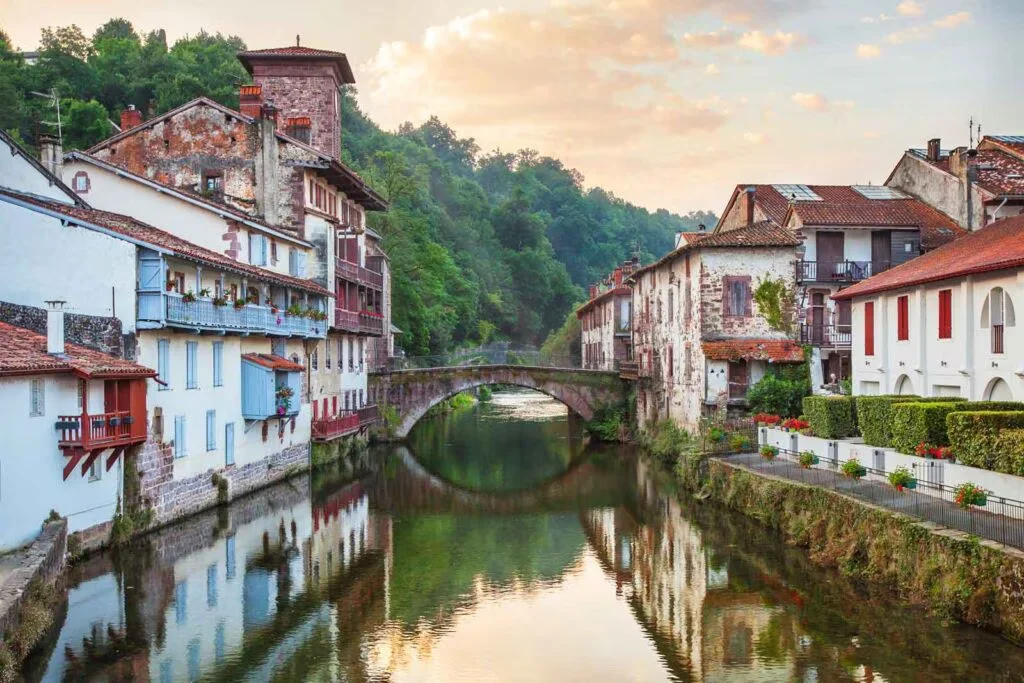
Saint-Jean-Pied-de-Port (in Basque, Donibane Garazi, and in Spanish, although unofficially, San Juan de Pie de Puerto) is a small medieval town in the Pyrenees. Today it belongs to France, but historically it was part of the ancient Kingdom of Navarre and proudly retains an obvious Basque-Navarrese flavor. It is also one of the most important starting points of the French Way of the Camino de Santiago.
Saint-Jean-Pied-de-Port on the Camino
Saint-Jean-Pied-de-Port has been, since the beginning of the pilgrimages to Compostela, a stop for pilgrims from all over Europe to regain strength before crossing the Pyrenees. Especially since, in the 13th century, the policy of the Kingdom of Navarre favored this pass over the Somport pass in the Aragonese Way, which had been the main one since the 11th century.
Today, this small Pyrenean town, with just over 1,500 inhabitants, boasts one of the most popular starting points of the French Way (more than 30,000 pilgrims a year), surpassing the neighboring Roncesvalles, just on the other side of the mountain border.
The link between Pied-de-Port and this route is evident. Especially after the end of winter, which makes the crossing much more difficult, its streets become filled with people from all over the world that come here to start the Camino facing the hard passes of Cize or the variant of Valcarlos/Luzaide. Their nerves mingle with the calm and the tiredness of those who already have several stages behind them. Or even of those who have started walking much earlier and are going to stop, at least this time, at the foot of the great mountain range that stands on the horizon.
Points of interest in Saint-Jean-Pied-de-Port
Founded in the 11th century as the “key to the kingdom of Navarre”, the small village of Garazi quickly became the head of the ancient Basque-Navarrese district of Ultrapuertos. Its strategic position explains its development, not only in military and governmental matters. Here the walkers who wanted to cross the mountains used to pay portage.
Historical vicissitudes ended up separating the whole shire from the current Navarre and the Iberian kingdoms, and explain the final integration into France. However, it doesn’t take much perspicacity to notice the flavor of Basque culture all around, both inside and outside the 15th-century walls that surround the city. Everywhere there are obvious references to traditional Basque architecture, place names, and family names.
The Citadel
Don’t leave Saint-Jean-Pied-de-Port without visiting the citadel — a unique defensive complex on the hill of Mendiguren, which was formerly the castle of the kings of Navarre, and later replaced by a 17th-century bastion designed by Antoine de Ville and further reinforced by the famous military engineer Sébastien Le Prestre de Vauban. The citadel maintained its military function until 1920, but today it is a pleasant space for recreation and strolling that also houses university facilities.
The approach to the Citadelle also offers a fine viewpoint, reached through the King’s Gate. As the citadel sits quite high, from there you get a good panoramic view of the whole town, set against the mountains of Munhoa and Oilarandoi in the background, and the Irouléguy vineyards below.
Now that you have a comprehensive picture of the city, you can walk down its main streets: the axis formed by the Rue de la Citadelle and the Rue d’Espagne.
The historic main street
One of the best activities in this small and, depending on the season, bustling town is strolling through its historic streets. After visiting the Citadel, you can come down to enter the city through its historic northern entrance: the Porte Saint-Jacques (Saint James Gate). This used to be the gate for those who came from Ostabat. The Rue de la Citadelle starts just there and runs south.
Just a few steps down you pass the old Bishops’ Jail — an emblematic building that was the residence of the bishops of Bayonne during the 14th century and, much later, in the 18th century, a civil prison. The jail never actually belonged to the bishops. Today the building houses permanent exhibitions and is open to visitors.
Very near the Bishops’ Jail you’ll find the Pilgrims’ Reception Center (39 Rue de la Citadelle), where you can get your pilgrim passport and a wealth of information and good advice.
From there, it’s a short walk to the Porte Notre-Dame, with its magnificent tower, which used to close the medieval quarter north of the river. Before crossing the river, you can visit the old Church of the Assumption of Mary — formally known as Notre-Dame-du-Bout-du-Pont, already mentioned in a document of 1213, although the forms of the portico and the Romanesque chapel suggest an even older origin. Like most Basque churches on either side of the border, this one has no altarpiece, but a spectacular choir decorated with magnificent stained glass. For devout pilgrims especially, it’s worth the stop. A blessing is traditionally given to pilgrims at the 7 p.m. mass (one hour earlier in winter).
Now pass through the gate and cross the Nive de Béhérobie — usually shortened to The Nive, and simply called Errobi in Basque.
Here the street changes its name: you are now on the Rue d’Espagne — the street of merchants and artisans since the Middle Ages. It ends at the Porte d’Espagne, where you leave the village heading for Santiago de Compostela.
To summarize: you’ll find most of Saint-Jean-Pied-de-Port’s points of interest along the axis formed by the Citadelle and Espagne streets. From north to south:
- Porte Saint-Jacques (Saint James Gate) — the northern entrance, arriving from Ostabat
- The Bishops’ Jail — medieval episcopal residence, later civil prison, now exhibitions
- The Pilgrims’ Reception Center — 39 Rue de la Citadelle
- The Church of the Assumption of Mary — the main church in town; pilgrim blessing at 7 p.m.
- The Eyheraberry bridge — over the Nive / Errobi
- Rue d’Espagne — shops and craftsmen since the Middle Ages
- Porte d’Espagne — the departure point for Santiago
Other points
Though this guide has focused on the Rue de la Citadelle and the Rue d’Espagne, the adjacent streets reward a wander and a few detours.
And if the crowds are getting to you — just after passing under the Notre-Dame tower and before entering the quarter south of the river — take the stone path on your left to the neighboring Eyheraberry esplanade, a quieter space that served as a venue for the revolutionary festival days during the French Revolution. The bleachers still stand in front of the altar dedicated to the cult of Reason.
Gastronomy, handicrafts, and markets
Every Monday (and every Thursday from June to September) there are busy and lively markets worth a visit. Handicrafts and clothing at the Place Charles de Gaulle; local food products at the Place des Remparts, just outside the Porte d’Espagne: hams, cheeses, jams, local honey, Irouléguy wine, cider, chocolate, Basque cakes and other pastries.
A good opportunity to whet the appetite before trying some typical dishes of the Basque-Navarrese culinary tradition: pigeon salmis, lamb sweetbreads, piperade, chipirons à la basquaise.
Getting to Saint-Jean-Pied-de-Port
From Bayonne: Several trains a day operated by SNCF. Journey time around 1h20 — check frequencies and possible connections at sncf.com.
From Pamplona: Bus only. Between April and November, Alsa-Conda runs a service with a journey time of 1h45. Timetables at alsa.es.
Outside that window, the practical option from the Spanish side is to take the bus to Roncesvalles and get a cab from there. There’s no cab rank in Roncesvalles — the nearest is in Valcarlos/Luzaide. Book ahead: Taxi Luzaide (taxiluzaide.com).
Limited services — plan ahead.
Detailed accommodation data for this town is being added.