
Roncesvalles / Orreaga
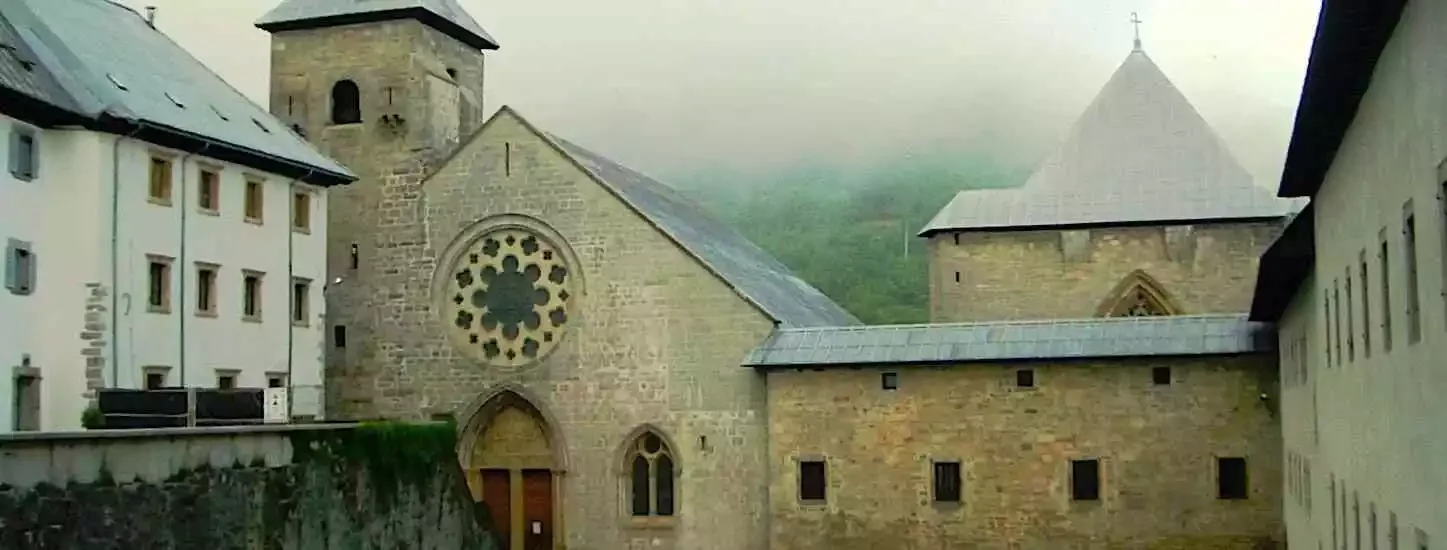
The Camino de Santiago has the power to take small towns with fewer than a hundred inhabitants and give them a global scale. That’s the case with Roncesvalles — Orreaga in Basque — a tiny Navarrese village nestled at 952 meters with fewer than twenty permanent residents.
The end of the first stage for more and more pilgrims coming from Saint-Jean-Pied-de-Port through Valcarlos/Luzaide or through the Cize Pass, or the starting point for many others heading toward Zubiri — this village, built around its once mighty abbey, is one of the symbolic centers of pilgrimage to Compostela. No wonder. In the days when walking the roads meant genuinely risking your life, a hospital at the top of the mountain would always be welcome. Even if only to rest, eat something hot, and recover some strength. That function, and no other, is what justified the existence of this place and the buildings that grew up around it.
Points of interest in Roncesvalles
Roncesvalles is one of the most interesting stops along the first kilometers of what’s known as the Camino Navarro — the French Route through Navarre. It’s full of buildings of major historical significance for the pilgrimage, built mostly during its heyday in the 13th century.
One of the most important is the pilgrims’ hospital, founded in 1127 by Bishop Sancho Larrosa and King Alfonso the Battler, fulfilling the royal tradition of supporting the Camino. The hospital’s records give some sense of how significant the pilgrimage was across different eras — in the 17th century, a time when medieval pilgrim fervor had already declined considerably, it was still distributing more than 25,000 food rations a year. Even so, what you see today is an early 19th-century reconstruction. Hence its neoclassical forms.
The most visited monument in Roncesvalles, though, is the Royal Collegiate Church of Santa María — a fine example of Navarrese Gothic, where the remains of King Sancho the Strong rest. There’s no precise record of when it was built, but other documents confirm it already existed in the early 13th century. The many fires it suffered over the years left it with a baroque exterior wrapped around a Gothic interior. In the presbytery, the Gothic carving of the Virgin of Roncesvalles presides over the church; to the right, the Chapel of the Holy Christ holds a life-size 19th-century crucifix.
The complex also includes the crypt, which supports the transept and chancel over the uneven terrain; the chapel-tower of Saint Augustine, which houses the tomb of King Sancho VII the Strong; and the cloister, built to replace the original, which collapsed under the weight of a snowfall in 1600.
Another important building is the Chapel of Sancti Spiritus, also known as the Silo of Charlemagne — according to the Song of Roland tradition, this is where the fallen Frankish fighters from the battle against the Saracens in 778 were buried. The crypt does contain an ossuary, but the human remains are most likely those of pilgrims — victims of blizzards, disease, or assault — who died in the hospital or trying to cross the mountains. What stands today dates to the 12th century, making it the oldest surviving building in the complex. The chapel is still used as a funerary temple: pilgrims who wish to be buried here still are.
Next to the Silo of Charlemagne is the small Church of Santiago, built in the 13th century. It was the center of the cult of Saint James for five centuries, until it fell into disuse. It was later restored, and now holds the bell that originally hung in the hermitage of the Savior at the Ibañeta Pass — the one that guided pilgrims through fog.
In front of the church stands the Itzandegia, a 13th-century Gothic building identified as the first sanctuary of the Virgin of Roncesvalles, today used as a pilgrim shelter. Its original function isn’t known for certain, but it was most likely an auxiliary building of the Collegiate — stables, hayloft, or servant quarters.
Don’t skip the museum, which holds some remarkable pieces — among them the chess set known as the Chess of Charlemagne.
Guided tours are available and need to be booked in advance: +34 670 289 997.
Getting to Roncesvalles
There are fewer public transport options than you might expect given its importance on the Camino.
From Pamplona, the only option is the bus — one daily departure, Monday to Friday at 13:50, Saturday at 16:00, no service on Sundays or public holidays. It departs from Pamplona bus station (platforms 20 to 25); journey time is about 1 hour 10 minutes. Both directions are operated by Autocares Artieda (autocaresartieda.com): €5 each way, plus €6 for a bicycle. No pets, except in a carrier in the hold.
In the other direction, the bus leaves Roncesvalles at 9:20, Monday through Saturday.
On Sundays and public holidays — when the bus doesn’t run — your only option is a taxi. Teletaxi San Fermín (taxipamplona.com) runs a Taxi Peregrino service — advance booking recommended, shared rides available for up to 8 people.
Limited services — plan ahead.
Detailed accommodation data for this town is being added.